
Allen Parish Projected Release Dates
A projected release date is the responsible corrections agency's current calculation of a future physical exit. It is based on the sentence, legally recognized jail credit, offense-date law, eligibility rules, earned credit, forfeiture, consecutive or concurrent terms, and later orders. It can move. An actual release date records that the custodian logged an exit. Full discharge means the relevant custody and supervision obligation has ended.
Those three dates can be different. A person can leave Allen Correctional Center and continue on parole or another community status. A person sentenced in the 33rd Judicial District can complete the custodial part and begin probation. A transfer from the Allen Parish Detention Center can also create a local release timestamp while custody continues with DPS&C or another agency.
- Projected release date
- The official current estimate of a future physical release, if a calculation is available.
- Actual release date
- The date the source agency recorded an exit from its custody.
- Discharge
- Completion of the relevant sentence or supervision duty when the official record uses that term.
- Diminution
- A lawful reduction in the custodial time through earned credit under the rules for that case.
Find an Allen Parish Release Date
Louisiana DPS&C explicitly documents the projected-date field through its telephone locator. Call 225-383-4580 and provide the DPS&C number or the person's name and date of birth. When applicable, the service may give the assigned facility, facility address and phone, assigned Probation and Parole district, and the exact phrase "projected release date." The public web search is useful for custody and supervision status, but DPS&C does not promise that every web result displays a future date.
- Identify whether the person is in the Allen Parish jail, Allen Correctional Center or other state custody, a federal institution, or pretrial custody.
- For a Louisiana state sentence, search LAVNS through VINELink by name or ID and verify the reporting agency. Then call the DPS&C locator for the documented projected-date field.
- For a parish sentence, call APSO at 337-639-4353 and check the 33rd Judicial District sentence. Ask which office holds the operative calculation.
- For a pretrial case, inspect bond and court orders, but do not publish a date the court or jail has not set. Other cases and detainers may still control.
- After the expected date, verify the actual exit with the current custody status, a release notice, or the custodian's record.
The DPS&C inmate-information page is the source for the phone route and the every-day LAVNS update description. The image below shows that official locator explanation.
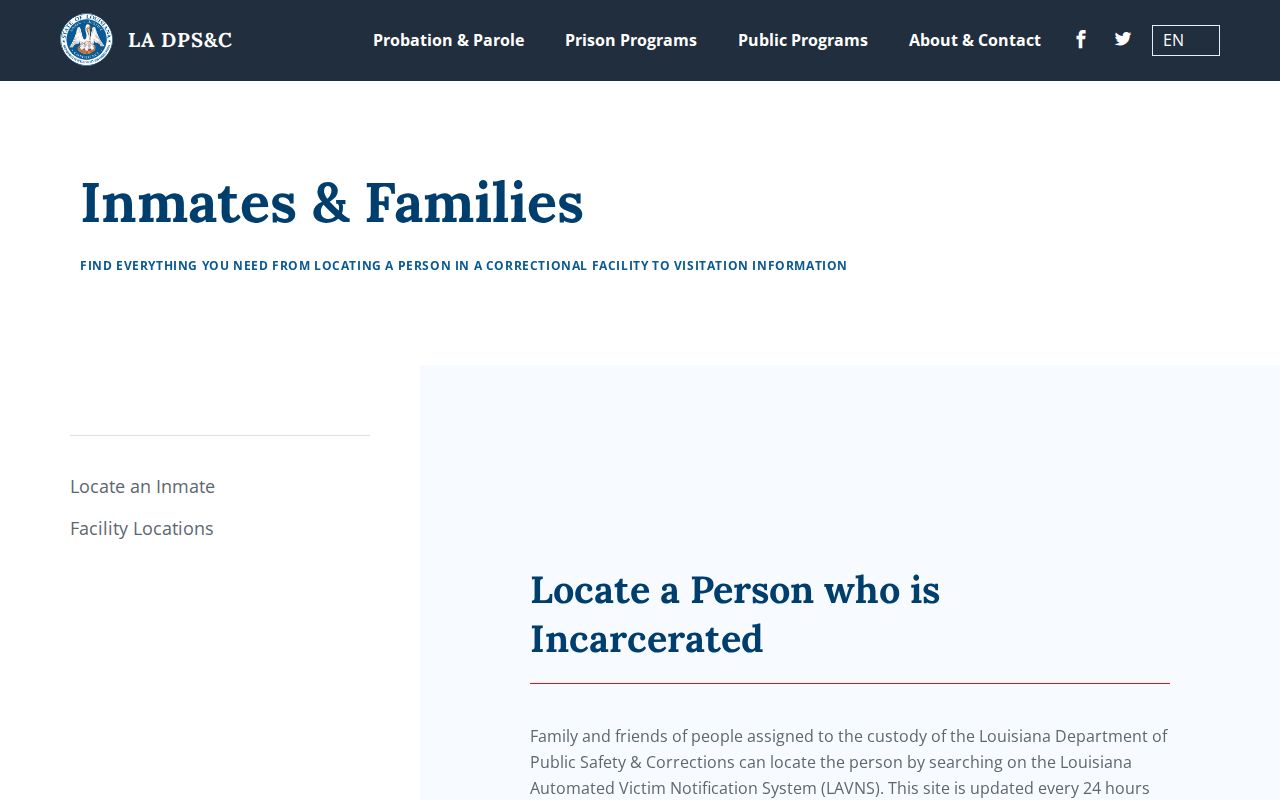
The page supports a telephone-first date check. It does not justify promising a projected date on each LAVNS result card.
Note: A newly sentenced case may have no Allen Parish projected release date until DPS&C receives the official sentence paperwork.
Allen Parish Release Paperwork Delays
The documented projected-date field is telephone-only in the reviewed public instructions, and new-sentence paperwork creates a local verification problem. DPS&C cannot finish a state calculation until it receives the official documents. A court sentence may therefore exist before the locator can supply a date. That gap is not proof of an error or an immediate release.
Start with the Allen Parish Clerk's Criminal Web Inquiry gateway or the court record to confirm the sentence and orders. A certified minute or judgment is stronger than a portal summary. Then ask DPS&C whether a calculation exists. The clerk proves what the court ordered, while DPS&C owns the operative state time computation.
A records request is not a substitute for the locator. R.S. 15:574.12 keeps most state inmate files confidential and leaves only limited facts public. Direct a sentence-calculation question to the operational locator instead of asking the public-records mailbox to create a new computation. If the issue is an Allen Parish jail sentence, APSO and the responsible statutory authority control that calculation.
Document the sequence when the calculation is delayed. Save the sentencing date and case number, note when the clerk supplied the judgment, and record when the locator was checked. If the sentence was amended, identify the later order rather than relying on the first portal entry. This does not permit a private calculation, but it gives the clerk and DPS&C a clear record to compare. It also helps distinguish a missing input from a date that changed after a completed computation.
Allen Parish Post-2024 Release Rule
For an eligible felony committed on or after August 1, 2024, Louisiana R.S. 15:571.3.1 permits diminution up to a maximum of 15 percent of the imposed sentence. This maximum is the source of the shorthand that a person may serve about 85 percent. The statute does not guarantee release at exactly that point. Credit must be earned, the case must qualify, and the responsible official must calculate it.
The basic credit does not apply to a person convicted of a sex offense under R.S. 15:541 or sentenced as a habitual offender under R.S. 15:529.1. Other qualifying credit under R.S. 15:828 may have its own rules and exclusions. The post-2024 regime also does not award this good-time credit on presentence time recognized under Code of Criminal Procedure article 880.
State and parish authority are not interchangeable. The DPS&C secretary controls state calculations, while statutory facility authority controls qualifying parish calculations. Even when the arithmetic seems simple, offense classification, legal exclusions, jail credit, forfeiture, and sentence structure make a self-calculated date unsafe.
Older Allen Parish Release Regimes
Earlier offenses remain under older versions of R.S. 15:571.3. One percentage cannot be applied across those cases. For a qualifying parish-prison sentence without hard labor, the researched rule generally allowed 30 days of credit for each 30 days in actual custody. A qualifying first crime of violence used a different rate, while a second crime of violence was excluded.
State DPS&C cases also varied. Qualifying nonviolent felony cases could use a rate of 13 days for seven actual days. A qualifying first violence case within the cited post-November 1, 2017 regime used one day for three, and certain fourth or later nonviolent cases used one for two. Habitual-offender status, sex-offense provisions, sentence wording, and other qualifications can override a general description.
The offense date selects the legal regime, not the date a person asks for the calculation. The judgment, prior record, and statutory exclusions then shape eligibility. Allen Parish readers should ask the sheriff or DPS&C for the official result instead of combining rates from different eras.
Note: Historic rates describe legal frameworks, not a calculation for any named Allen Parish person.
Why Allen Parish Release Dates Change
A projected date is recalculated when a controlling input changes or arrives late. Some changes shorten the expected term. Others extend it or reveal that another custodian will take over. The date should always be tied to the source and the day it was checked.
| Factor | Effect on the date | Who confirms it |
|---|---|---|
| Earned credit | Qualifying credit can reduce physical custody within the controlling statute. | Sheriff or DPS&C calculation authority |
| Forfeiture | R.S. 15:571.4 permits loss of credit for escape, failure to return, and specified misconduct. | The responsible corrections agency |
| New court paperwork | A corrected judgment, jail credit, or later order can change the computation. | Court record plus the calculating agency |
| Sentence structure | Consecutive and concurrent terms produce different endpoints. | DPS&C or the parish calculation authority |
| Detainer or transfer | The first custody may end while another begins, so community release does not follow. | Each involved custodian |
| Parole action | A grant authorizes later processing but may not create an immediate exit. | Committee on Parole and DPS&C |
| Revocation or new conviction | New custody or sentence action can alter the expected date. | Court, P&P, and the custodian |
The defensible sequence is to begin with the imposed term and lawful jail credit, identify the offense-date statute, classify exclusions, apply credit actually earned, subtract forfeitures, and incorporate sentence structure and later orders. Only the responsible agency can issue the operative result.
Confirm Allen Parish Actual Release
When the projected day arrives, check the current source again. A LAVNS status that moves to released, out of custody, or community supervision shows the reporting agency's update, but it does not rule out a transfer. Confirm an Allen Parish Detention Center exit through APSO's release record. Confirm an Allen Correctional Center exit through DPS&C and, if supervision follows, the assigned P&P district.
Registering for an alert can help track the next custody change. The Allen Parish VINELink release check explains the person search, PIN acknowledgement, and Louisiana's separate Victim Outreach layer. A failed alert does not override the record owner, and federal BOP or ICE custody requires a different locator.
Diminution can lead to physical release before the full term ends. Under the controlling Louisiana provisions, a person may move to a parole-related status for the balance, and a split sentence can move into probation. Therefore the actual prison exit, the start of supervision, and final discharge should be recorded as separate events.
For a parish-jail record, capture the booking number and exact release timestamp while the APSO 48-hour card remains visible. The card does not state the release reason or destination. A transfer can look like a release in the first database, so ask APSO what public receiving-agency field it can confirm. For a state record, keep the last projected date as historical context, then replace it with the actual status only when DPS&C records the custody change.
Federal dates follow another route. BOP can display a future date for a sentenced federal person, but its own record explanation warns that calculations can change. A past date and a released status establish only that BOP no longer holds the person. The federal judgment explains supervised release, while ICE or another custodian may hold the next status. Geography in Oakdale does not turn a federal release into an Allen Parish jail event.